


The Man and His Family

By the time Jonathan Balls’s coffin was opened in 1846, his death had become the subject of village whispers. The strange objects buried with him would only deepen the mystery. But his story began decades earlier, in the Norfolk villages of Tunstead and Brunstead.
Jonathan was born in Tunstead in 1767, the son of John and Barbara Balls, and one of nine children. His family later moved to nearby Brunstead, where he met Elizabeth, the woman who would become his wife. Together they had seven children: three sons and four daughters. On paper, theirs looked much like any other labouring family of the period.
Raising seven children on an agricultural labourer’s wages would have left little margin against hardship. Records show that Jonathan received parish relief before the Poor Law Amendment Act of 1834. In later life, he appears to have relied increasingly on his married daughters for support.
Beyond these outlines of family and working life, little is known about Jonathan’s personal circumstances. The newspaper reports published after his death, however, describe a man with a troubled local reputation.
Those accounts linked him to earlier fires, including allegations that he had set fire to his own cottage and the tithe barn at Stalham. Another story concerned a payment said to have been made to influence his evidence about a hayrick fire. How much of this can be substantiated remains uncertain. These reports offer a glimpse of the reputation attached to his name, though they cannot, on their own, establish what he had done.
To follow what happened next, we need to look beyond Jonathan himself. His wife Elizabeth, their children and the households those children formed would all become part of the story. The different surnames in the newspaper reports can obscure those connections: these were daughters, sisters, parents and grandchildren within the same extended family.
We begin with his wife, Elizabeth, whose life is more sparsely recorded, but whose care and final illness would become central to the later inquiry.
Born in Brunstead in 1764, Elizabeth Burton married Jonathan Balls at the village church on 3 February 1795. Together they had seven children, three sons and four daughters. By the 1841 census, she was living with her family in Happisburgh.
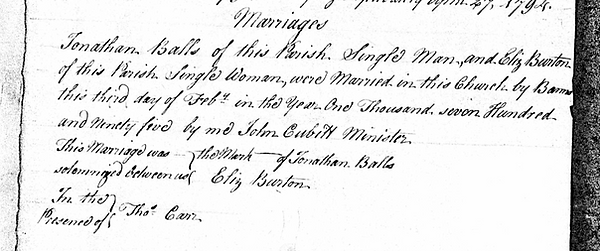
Few details of Elizabeth’s own life survive. We can trace her through her marriage, the births of her children and her death in 1845, but know little of her daily life. In her later years she was bedridden and needed help with her care. Sarah Kerrison, whose testimony would become central to the investigation, appears in the household in the 1841 census.
The later inquest testimony offers a brief glimpse of Elizabeth within the family. Sarah described her as very fond of her daughters, and them of her. We also learn that Elizabeth had disapproved of her daughter Maria’s marriage to William Lacey—a marriage that would itself come under scrutiny after Maria’s death.

Jonathan and Elizabeth had three sons: Jonathan, Robert and James. Although they do not appear in our drama, they belong in the family’s story.
Their son Jonathan married and lived in nearby Catfield. He died in 1834, aged 36. Robert survived his father by almost twenty years, dying in Great Yarmouth asylum in 1865. James’s later life remains uncertain: we have not yet been able to trace what became of him.
The surviving records allow us to follow their four daughters more closely. It is through their households, their losses and their testimony that much of the family’s story emerges.
Jonathan and Elizabeth’s four daughters formed the households that would become central to the later investigation. Maria married William Lacey; her sisters became Mary Green, Elizabeth Peggs and Ann Pestell. Their married names recur throughout the newspaper reports, sometimes obscuring the fact that these women were sisters.
Tracing their children has proved more difficult. Names recur within the families, sometimes given to a later child after an earlier child had died. The newspaper accounts provide numbers of births and deaths, but we have not yet been able to match every child to a surviving parish entry. What follows brings together the family connections we have established, while leaving the remaining gaps open.
Maria Balls


We begin with Maria Lacey, whose death in 1835 would be revisited eleven years later during the investigation into her father. The testimony given then offers glimpses of a short and troubled marriage, the loss of an infant son, and concerns about her treatment that had gone un-investigated at the time.
Maria Balls married William Lacey in 1833, shortly after the birth of her first child, James. According to her sister Mary’s later testimony, Maria had left her position in service at North Walsham because she was pregnant. Jonathan and William’s mother helped arrange the marriage. Elizabeth opposed it; her daughter Elizabeth Peggs recalled that she had offered to care for Maria’s child.
Jonathan promised to furnish the couple’s home, but, according to Elizabeth Peggs, lacked the means to fulfil that promise. Mary remembered the couple being comfortable together at first, before quarrels began after they moved to William’s mother’s home. Looking back during the 1846 inquiry, she believed the broken promise had contributed to William’s ill-treatment of Maria.
A second child, Robert, was born in 1835 and died shortly afterwards. Maria herself died following an illness after the birth. When the inquiry revisited her death eleven years later, witnesses described an unhappy marriage and allegations of violence. Mary testified that William had threatened to treat Maria worse if she recovered from her confinement.
The witnesses did not agree about everything they had seen. Their descriptions of marks on Maria’s body differed, and some accounts relied on what others had said. Nevertheless, the coroner expressed his belief that she had been badly treated. Maria’s death would now be examined again, amid questions about both her marriage and her father.
Mary Balls


Born in Brunstead in 1810, Mary Balls married Robert Green, who was born in Happisburgh in 1804, on 5 October 1829. The couple lived in East Ruston, near Happisburgh, where they raised their family.
Tracing their children has proved difficult. William and Martha were names given to later children after earlier children bearing those names had died. This repetition makes it particularly important to distinguish between individuals in the parish records. One contemporary newspaper account stated that Mary had eleven children, seven of whom had died. We have not yet been able to identify every child confidently in the surviving records.
Three of their children—Maria, William and Martha—feature in our drama. Maria died first; William and Martha later died on the same day. In 1846, the remains of these children were exhumed from East Ruston churchyard as the investigation into Jonathan Balls widened.
Mary also appears in testimony about her mother Elizabeth’s final illness. Sarah Kerrison recalled that both she and Mary became sick after breakfast at the Balls household. Mary had attributed her sickness to herring she had eaten. Their illness subsequently became part of the evidence considered at the inquiry, although it did not by itself establish that either woman had been poisoned.
The family’s story continued beyond the inquest. By the 1861 census, Mary and Robert were living in Scarborough, where Robert’s occupation was recorded as “scavenger”. This later record takes their story beyond Norfolk, although we have not yet established when or why they moved.
The examination of the Green children’s remains and the differing medical findings will be explored in Poison and Proof.
Elizabeth Balls

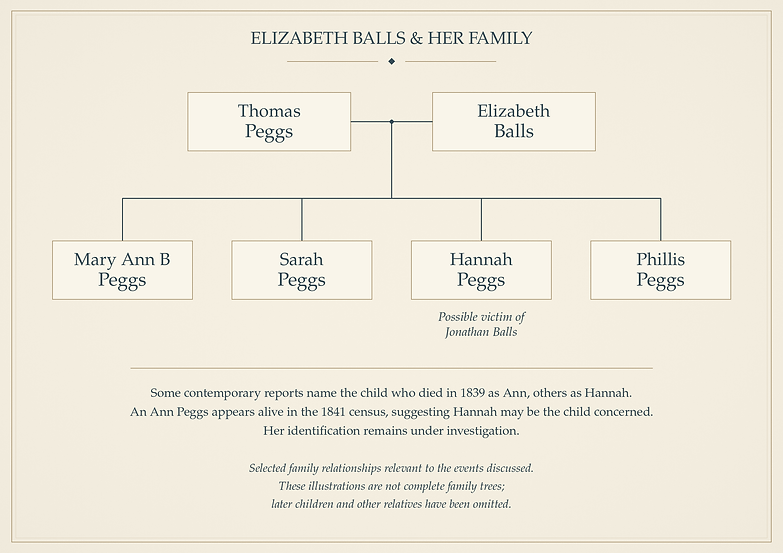
Elizabeth Balls was born in Brunstead in 1805. On 19 January 1825, she married Thomas Pegg, an agricultural labourer from Stalham. The family’s surname appears in records as both Pegg and Peggs.
By 1835, Elizabeth and Thomas were living in Ingham, where the census records place Elizabeth with her family in 1841, 1851 and 1861. Like her sisters, she raised a family whose history would later be examined through the deaths of its children.
One of those deaths presents a difficulty that has followed us through the research. Newspaper accounts name a daughter who died in 1839 as either Ann or Hannah, linking her death to suspicions surrounding Jonathan Balls. Our reading of the family records points towards Hannah: an Ann Peggs was still living and listed as fourteen years old in the 1841 census. We have therefore used Hannah in the accompanying family illustration, while acknowledging that the conflicting reports leave some uncertainty.
The audio drama uses the name Ann, following one version of the newspaper accounts. The Journal allows us to explain that choice and record how further research has changed our understanding.
Elizabeth’s own life continued for more than three decades after the investigation. By 1881, she was living in Barton Turf with her daughter Mary Ann, recorded there simply as Ann. Elizabeth died at her daughter’s home in 1882.
Elizabeth was also called to give evidence during the investigation. In the Norfolk Chronicle’s report of 6 June 1846, she described her daughter’s final illness and death on 7 June 1839. The child had visited her grandfather shortly before becoming ill, but Elizabeth said she had suspected nothing wrong at the time and believed the illness was smallpox. She sent for Mr Clowes, but her daughter died before he arrived. When the remains were examined in 1846, no arsenic was detected; the later report of the inquiry records that the verdict was left open.
Her evidence also reached back to the marriage and death of her sister Maria Lacey. Elizabeth recalled their father’s promise to furnish Maria’s marital home and described what she had witnessed during her sister’s illness. Her testimony helped the inquiry revisit events within both households, although it could not settle who, if anyone, had caused the deaths.